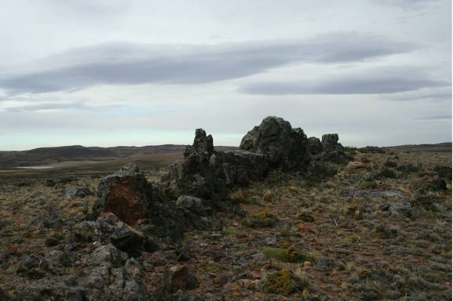
Location
The La Rosita M.D. is located in the southwest corner of the Deseado Massif, 11 km east of the town of Gobernador Gregores, Argentina (see Figure 1). The La Rosita M.D. constitutes a 2,900 hectare land package neighbouring the now closed Mina Martha and Manantial Espejo silver mines.

Figure 1: Deseado Massif, Magna Terra Minerals Property Map.
Geology and History
La Rosita occupies a basin measuring approximately 4 by 4 km, which is formed in andesitic and dacitic volcanics and is occupied by highly deformed cherts, limestones and siltstones, which are locally altered and mineralized. The formation of this basin is the result of extension and wrenching related to major regional and district-scale structures which strike north-northeast, north-south, north-northwest, northwest, and west-northwest (see Figure 2).

Figure 2: Regional geological map at 1:250,000 (4969-1 Gobernador Gregores) illustrating the geological setting of La Rosita.
The formation of the basin provided a site of high potential for geothermal and hydrothermal fluid flow, as well as the topography for sedimentation, which would ultimately cover the favourable stratigraphy and much of the evidence of hydrothermal activity (see Figure 3). The presence of mineralization in sinters, accompanied by associated soft sediment deformation, implies an environment in which sedimentation was accompanied by geothermal activity in the Jurassic period and that hydrothermal fluids, associated with structures in the underlying volcanics, had to pass through this column of unfavourable stratigraphy before brecciating and mineralizing sinters at the surface.

Figure 3: Regional stratigraphy illustrates vein-forming units observed at Mina Martha and Manantial Espejo relative to the higher stratigraphy observed at La Rosita.
Geological mapping and sampling were carried out in 2009 by a previous operator and were accompanied by a geophysical IP and ground magnetic campaign. In September of 2010, 11 diamond holes were drilled, the most significant being drill hole DDHLR04, which included an intercept of 3 m with 0.761 ppm Au and 926 ppm Cu at a depth of 83 m.
Drilling on the project in 2010 returned multiple low-grade Au intercepts (see Figure 4). Of the 12 holes drilled, 5 hit one to several discrete intervals of at least 50 ppb Au and 2 holes intersected “significant mineralization”, considered to be the equivalent of 2-3 m (not true thickness) of at least 700 ppb.

Figure 4: Table of Au drill intercepts.
The Company has used magnetic, gradient array, and IP section data to re-evaluate the property in terms of known regional structure and stratigraphy.
Three magnetic environments or domains are described (see Figure 5):
Domain I: Zones of high magnetism which have a generally northwest to southeast orientation. These are apparently structurally controlled and may be related to fault-bounded blocks of Andesite or perhaps basement blocks. These magnetic highs are generally unmineralized, with the exceptions being sinter formation along the structurally controlled flanks of the blocks.
Domain II: Magnetic lows, which are generally sub-circular to elongate zones. These zones occur between the magnetic highs of Domain I and exhibit a general northwest to southeast orientation. These zones may be related to changes in lithology, for example, felsic volcanics infilling half grabens between blocks of andesite, or they could be related to destruction of magnetite in the andesite, which may be occurring as hydrothermal fluids flow along fault boundaries, or more likely a combination of both.
Domain III: Zones of generally moderate magnetism, cut by magnetic highs and with strong variations in magnetic gradient. This domain occurs in the centre of the study area and exhibits a northeast-southwest orientation. These zones may be related to sub-volcanic bodies such as rhyolitic dykes. The Company notes, however, that the Domain III area occurs in the centre of the basin where north-northeast and northwest structures intersect, making it an area of potential fluid flow and mineralization.


Figure 5: Reduced to the Pole Ground Magnetics with inferred structures, sinter outcrops and Au mineralization.
The gradient resistivity data (see Figure 6) are combined with the Magnetic domain data, showing that most of the surface mineralization is associated with the more resistive areas and specifically with west-northwest and locally northeast-striking structures. The largest and strongest resistive zone is oriented west-northwest along a dilatational zone.

Figure 6: IP Resistivity with Magnetic domain overlay, inferred structures, sinter outcrops and Au mineralization.
The Company concludes that while the structurally controlled basin provided multiple zones of potential fluid flow and mineralization, the 2010 drilling campaign targeted Au in outcropping sinters and for the most part these holes were too shallow, collaring in and ending in the andesite porphyry. The Company is now considering structural targets in resistive and mildly chargeable anomalies which represent dacitic and ignimbritic stratigraphy beneath the andesite.
Opportunity